On Tue, Feb 3, 2026 at 3:15 PM 程亚军 <chengyajun@xxxxxxxxxx> wrote:
Hi, Sindhu,Please see my reply in BLUEHi, Gaurang,The third reply to Sindhu might also be able to clarify your doubts.Furthermore, do you agree with the following scenario: If a non-AP STA sets the PS Management subfield to 1 on the NPCA PC, then when it switches back to the BSS PC, will this non-AP STA remain in the doze state without performing any exchanges with the AP if it has no further pending traffic?Looking forward to further discussion.Thanks,Yajun-------------------------------------------------------------------------------------------------------------------------------------------------------------------------Hi Yajun,I have some comments on the following change you are proposing in 25/1924r3:37.18.5 Switching back from the NPCA channelWhen the STA switches back to the BSS primary channel, it shall:1) replace the current values of the variables QSRC[AC], CW[AC] and the backoff counter for each EDCAF with the values that it stored when it switched to the NPCA primary channel.2) resume the backoff procedure, except that:— the STA is in doze state when it switches back to the BSS primary channel. (#4462)Comments:• The above change literally means that the STA must be in doze state when switching back to the BSS PC from the NPCA PC. This I think is not your intention
- YC: No, it doesn’t means the STA must be in doze state. CID #4462 raised that when the STA operates on NPCA PC and sets PS Management subfield to 1 to go to doze state, the STA won’t resume the backoff procedure after it switches back to the BSS PC.
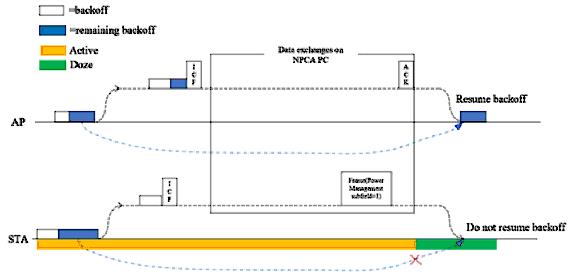 • Your intention seems to be to omit backoff procedure for those STAs which are already in doze state. This too does not seem intuitive. Active or doze state of a non-AP STA is from the perspective of the AP when the AP intends to transmit to the non-AP. The non-AP can stay in doze state and continue to perform backoff and even transmit to the AP.
- YC: I may not agree with you that the non-AP STA in doze state can perform backoff or even transmit to AP.
Could you please elaborate on how the non-AP STA perform backoff procedure or even transmit when it is in doze state?Personally, the situation you mentioned where a non-AP STA can continue to perform backoff and even transmit to the AP, might occur when the non-AP STA is in AWAKE state rather than doze state.According to baseline(REVmf 1.0) ,
- (P2116L21) Physical and virtual CS functions are used to determine the state of the medium.
- (P2160L59) After this DIFS or EIFS medium idle time, the STA shall then generate a random backoff count…
The detection of the medium mainly involves physical Carrier Sensing and virtual carrier sensing/NAV, the former requires the non-AP STA to detect the channel by activating the radio frequency transceiver, while the latter requires receiving and decoding the frames within the channel.But, the definition of (P2731L64)Doze “STA is not able to transmit or receive non-WUR PPDUs and consumes very low power” means that the STA in doze state cannot detect the medium.Obviously, the non-AP SAT in doze state cannot perform backoff procedure.• Why is the backoff procedure being linked to the doze state?
- YC: Let me clarify it once again though I have clarified in the previous email.
I did not deliberately link/couple this to NPCA. That was not my intention. However, when considering the new feature NPCA, this issue arose.In the baseline, if the STA successfully exchanges frames with its associated AP to change its power mode and then enters doze state, it means the STA has accessed the channel and the backoff counter is zero.The introduction of NPCA PC creates a new scenario. We need to determine if the backoff procedure on the BSS PC should be resumed when the NPCA STA return to the BSS PC. This is an unprecedented issue in legacy Wi-Fi standard/baseline.The current wording in bn Draft 1.0, stating that 'the NPCA STA SHALL resume the backoff procedure,' may be overly prescriptive and technically inaccurate. This statement is problematic as it suggests that the backoff procedure MUST be resumed regardless of the specific state of the NPCA STA.The issue we are discussing is that the NPCA STA doesn’t resumes the backoff procedure if the NPCA STA is in doze state when it switches back to the BSS PC. If we don't exclude this situation, then what should the NPCA STA do when it in doze state? Must it wake up and resume the backoff procedure? This seems to be contrary to the original intention of saving energy, doesn't it?Again, I agree with that the non-AP STA in PS mode can perform backoff or even transmit, e.g. awake state. That is the reason why I add the exception that the non-AP STA is in doze state rather than in PS mode, i.e., ‘except that: the STA is in doze state when it switches back to the BSS primary channel. (#4462)’Regards,Sindhu-----邮件原件-----
发件人: Sindhu Verma <sindhu.verma@xxxxxxxxxxxx>
发送时间: 2026年2月3日 3:20
收件人: 程亚军 <chengyajun@xxxxxxxxxx>
抄送: STDS-802-11-TGBN@xxxxxxxxxxxxxxxxx
主题: [External Mail]Re: [STDS-802-11-TGBN] CR doc-25/1924: Backoff Procedure after Switching Back to BSS PCH[外部邮件] 此邮件来源于小米公司外部,请谨慎处理。若对邮件安全性存疑,请将邮件转发给misec@xxxxxxxxxx进行反馈