Date: Tuesday, October 6, 2026 at 06:43
To: STDS-802-11-TGBN@xxxxxxxxxxxxxxxxx <STDS-802-11-TGBN@xxxxxxxxxxxxxxxxx>
Subject: [STDS-802-11-TGBN] 答复: [STDS-802-11-TGBN] Request to defer SP on 26/1704
Hi Kerstin,
Thanks for your discussion. Please find my response inline.
Regards
发件人: Kerstin Johnsson (Nokia) [mailto:kerstin.johnsson@xxxxxxxxx]
发送时间: 2026年10月1日 9:20
收件人: huangguogang <huangguogang1@xxxxxxxxxx>; STDS-802-11-TGBN@xxxxxxxxxxxxxxxxx
主题: Re: [STDS-802-11-TGBN] Request to defer SP on 26/1704
Hi Guogang,
Regarding CIDs 19895/19902:
For Request DL SN Not Transferred = 1, I’m not clear how the original MSDU order is preserved when an older MSDU is forwarded later from the current AP MLD.
For example, suppose packet 1 is still buffered at the current AP MLD, while the target AP MLD receives newer packets 2 and 3, assigns:
packet 2 → target AP MLD SN 0
packet 3 → target AP MLD SN 1
and transmits them. Later, packet 1 is forwarded to the target AP MLD and assigned:
packet 1 → target AP MLD SN 2
The non-AP MLD therefore sees:
SN 0 = packet 2
SN 1 = packet 3
SN 2 = packet 1
At that point, it has no way to determine from the SNs that packet 1 originally came first.
So I think “prioritize the transmission of MSDUs forwarded from the current AP MLD” needs to be made more explicit. Would something like the following work?
When Request DL SN Not Transferred is equal to 1, for each TID, the target AP MLD shall not assign sequence numbers to new MSDUs received from the Distribution System until all MSDUs forwarded from the current AP MLD for that TID have been assigned sequence numbers.
[HGG]I’m not sure this description is more clearer than the original one. And I received comments from other members, the forwarded MSDUs are also received from the DS. Hence, it’s not accurate to use from the DS or not to distinguish these two categories of MSDUs. We can have more discussion.
But would we also need some way for the target AP MLD to know that the current AP MLD has finished forwarding the older MSDUs for that TID? Do we need a forwarding-complete indication, or is that already provided somewhere else?
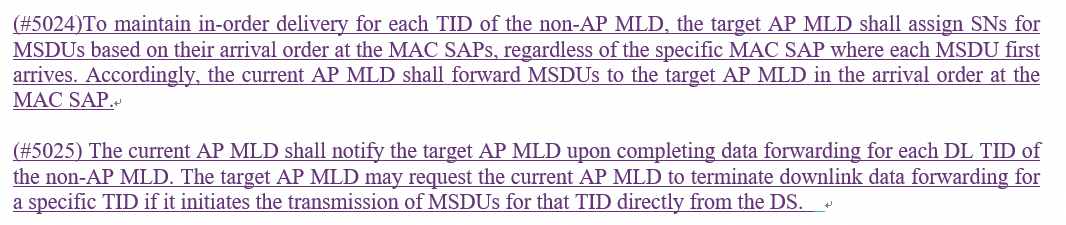
[HGG] I agree with you. In my original version (11-25/1993r9, as shown in below), the current AP MLD can inform the target AP MLD the data forwarding is finished. And the target AP MLD also can inform the current AP MLD to stop the data forwarding if the target AP MLD wants to transmit non-forwarded MSDUs. Based on the offline discussion, some members want to leave the data forwarding to the implementation and don’t want to add ‘shall’ requirements. That’s why I remove the above text from this version. But we can have more discussion if you have any suggested text.
BR,
Kerstin