Hi Mike and all,
Document 25/1830r3 has been uploaded including the changes discussed during the last 11mf adhoc meeting, which includes the resolutions for CID 156/157/158.
The CID 157/158 have been marked as Ready for Motion. The resolutions for those CIDs are to refine the calculation methods of T_tx and T_rx, with which the T_tx/T_rx will only include
the time interval when all NAVs are zero.
|
CID |
Page |
Clause |
Comment |
Proposed Change |
Resolution |
|
157 |
2874.06 |
11.10.9.4 |
In the RM noise histogram report, the definition of the T_tx is "the frame transmission time during the Measurement Duration ". Under MU TxOP case, there can be cases that the
a STA can transmit when the (intra) NAV is not zero. In this case, if the T_nav has included the time when (intra) NAV is nonzero, and the T_tx also includes the transmission time when (intra) NAV is nonzero, then those overlapped time is calculated twice. |
Proposed change is to explicity state that the T_tx can only include the transmission time when any NAV is zero. For example, the T_tx is the frame transmission time when any NAV
is zero during the Measurement Duration. |
Revised Add additional condition of checking NAV value for calculating T_tx .
Incorporate the change for CID 157 in doc 11-25/1830r1 with tag #157 |
|
158 |
2874.07 |
11.10.9.4 |
In the RM noise histogram report, the definition of the T_rx is "the frame reception time during the Measurement Duration ". Under TxOP case, there can be cases that the a STA
can receive when the (intra) NAV is not zero. In this case, if the T_nav has included the time when (intra) NAV is nonzero, and the T_rx also includes the transmission time when (intra) NAV is nonzero, then those overlapped time is calculated twice. |
Proposed change is to explicity state that the T_rx can only include the reception time when any NAV is zero. For example, the T_rx is the frame reception time when any NAV is zero
during the Measurement Duration. |
Revised Add additional condition of checking NAV value for calculating T_rx . Incorporate the change for CID 158 in doc 11-25/1830r1 with tag #158 |
And the corresponding redline changes in REVmf D1.0 P2874L06. Besides the CID’s original comments, another reason for the changes is that under the current definitions, there can
be case that the (T_nav+T_tx+T_rx) could be equal or larger than D_m, which is not reasonable for the equations shown below.
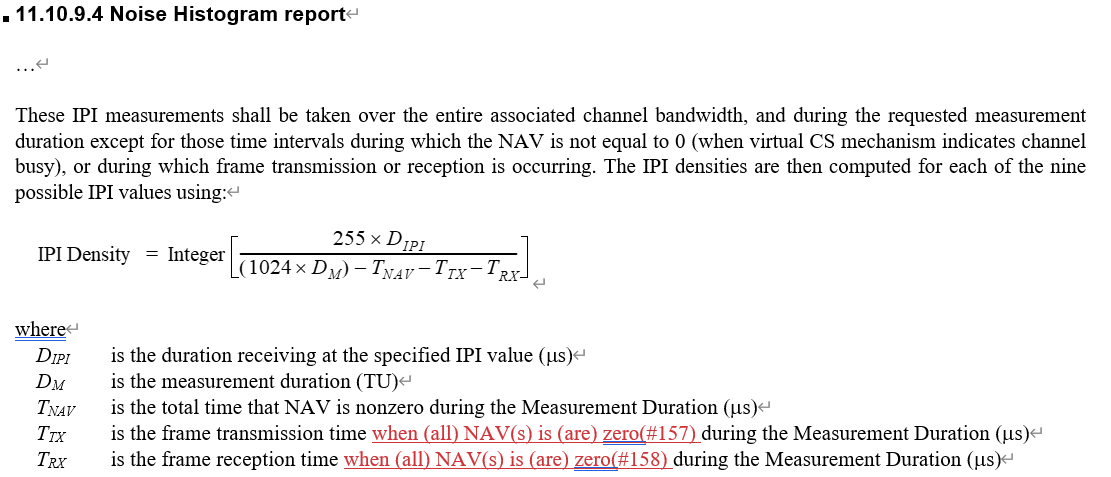
During the discussion in the adhoc meeting, the resolutions have received an objection comment, which shows concerns that the changed definition of T_tx/T_rx might be against the
(existing) legacy devices implementations, as it’s not clear how the legacy implementations have interpreted the current definitions of T_tx/T_rx. So more feedback is welcomed for those CIDs, and if you have any concern/feedback, please respond back to this
thread. Thanks.
Regards,
Yanchao Xu
To unsubscribe from the STDS-802-11-TGM list, click the following link: https://listserv.ieee.org/cgi-bin/wa?SUBED1=STDS-802-11-TGM&A=1