Hi Rich,
Yes, Pa = CDF when added noise (MLSD implementation penalty) is set to 0.
For COM calculation from DER, I had a couple of slides (see below) in my Q3 OIF presentation (oif2026.525), that due to time limit
had to remove in shakiba_3dv_01a_2611. I intend to present this COM calculation for the 2nd-order MLSD in a separate contribution in a future 802.3dv meeting. I may modify this to make it more clear and perhaps more accurate, but for now you can
use it only for reference in answer to your question.
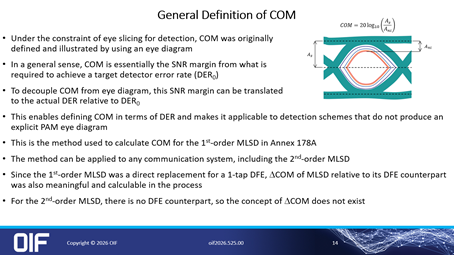
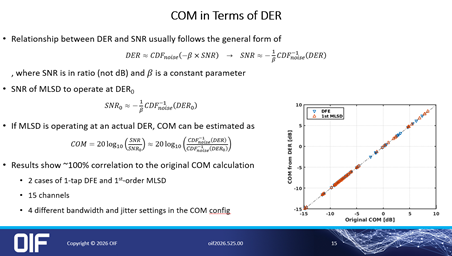
The last equation in the second slide above is what I used to calculate COM_MLSD. As I mentioned in my last email, this is the overall
COM with MLSD which can be decomposed to what you called COM_PR and then a delta COM term. At this time, I do not see a need for this decomposition, since as I said COM_PR is only conceptual and fictitious in contrast to before, where for the 1st-order
MLSD COM_DFE had a real physical parameter for the DFE alternative to the MLSD.
Regards,
Hossein
From: Richard Mellitz [mailto:000014533bad0b9c-dmarc-request@xxxxxxxxxxxxxxxxx]
Sent: November 19, 2026 2:08 PM
To: STDS-802-3-COM@xxxxxxxxxxxxxxxxx
Subject: Re: [802.3_COM] COM commit request: PR{1,1} MLSD2- shakiba_3dv_01_2611
Does
Pa = CDF because added noise is 0 for the MLSD11 method?
For non MLSD COM:
COM = 20*log10(-A_s/CDF_inv_ev(param.specBER, PDF, CDF))
Reference this equation (in replay below)
COM_MLSE = 20*log10(CDF_inv_ev(DER_MLSE_trunc, PDF, CDF)/CDF_inv_ev(param.specBER, PDF, CDF));
When
DER_MLSE_trunc= param.specBER (DER0), COM is zero.
Can you explain?
… Rich
|
From: Hossein Shakiba <hossein.shakiba@xxxxxxxxxx>
Sent: Wednesday, November 18, 2026 9:10 PM
To: Richard Mellitz <Richard.Mellitz@xxxxxxxxxx>;
STDS-802-3-COM@xxxxxxxxxxxxxxxxx
Subject: RE: COM commit request: PR{1,1} MLSD2- shakiba_3dv_01_2611
|
⚠ CAUTION:
This email originated from outside the organization. Do not click links or open attachments unless you recognize the sender and know the content is safe.
|
Hi Rich,
- At this level of analysis, same decompositions apply to PAM6. Just use L = 4 for PAM4 and L = 6 for PAM6.
- I did not provide the _expression_ for COM calculation from DER in the slides, however, you can see it in the COM code I sent to
Hansel (line 2599):

This is different from the _expression_ in Annex 178A in the sense that it directly calculates COM without needing to calculate delta COM and COM_DFE. The
reason I avoided to go through that incremental calculation is to avoid the DFE that does not exist for this 2nd-order PR. I noticed that you replaced COM_DFE with COM_PR and then added the so-called delta COM. If this decomposition is still desired,
I can provide updated expressions, which of course will yield the same overall COM result. Note that for the 1st-order MLSD, there was a COM advantage (delta COM) over the realizable DFE alternative, but in this case, I think what you meant by COM_PR
is a fictitious upper limit from a non-realizable receiver and then a negative delta COM for the MLSD relative to that fictitious upper limit.
I hope this answers your questions and thank you for following up on this.
Regards,
Hossein
From: Richard Mellitz [mailto:000014533bad0b9c-dmarc-request@xxxxxxxxxxxxxxxxx]
Sent: November 18, 2026 11:27 AM
To: STDS-802-3-COM@xxxxxxxxxxxxxxxxx
Subject: Re: [802.3_COM] COM commit request: PR{1,1} MLSD2- shakiba_3dv_01_2611
Hossein,
On page 31 of
https://www.ieee802.org/3/dv/public/2611/shakiba_3dv_01a_2611.pdf, you develop DER as the sum of DER_jEE1, DER_jEE2, and DER_jEE3.
For PAM6, does the same decomposition apply—that is, is DER still the sum of DER_jEE1, DER_jEE2, and DER_jEE3—or does the decomposition into jEE terms change?
Annex 178A, equation 178A-48, defines COM as:
COM = COM_DFE + 20*log10(-P_an^-1(DER_MLSD)/As)
For the calculation in shakiba_3dv_01a_2611, can the DER developed on page 31 be substituted for DER_MLSD in equation 178A-48? If so, should COM_PR11 be used as the reference COM in place of COM_DFE?
Thank you
Rich Mellitz
Samtec
|
From: Hossein Shakiba <000029b7cabe11ea-dmarc-request@xxxxxxxxxxxxxxxxx>
Sent: Wednesday, November 11, 2026 9:00 AM
To: STDS-802-3-COM@xxxxxxxxxxxxxxxxx
Subject: Re: [802.3_COM] COM commit request: PR{1,1} MLSD2- shakiba_3dv_01_2611
|
⚠ CAUTION:
This email originated from outside the organization. Do not click links or open attachments unless you recognize the sender and know the content is safe.
|
Hi Hansel,
Thanks for this initiative. I noticed that you have attached the first version of my slides, what was presented was updated to include a backup section that includes
the math for error calculation. Please disregard the previous version and use the updated version attached to this email. By now, Kent has already updated the IEEE link to the new version.
Regards,
Hossein
From: Hansel DSilva [mailto:00004708d0869f3e-dmarc-request@xxxxxxxxxxxxxxxxx]
Sent: November 11, 2026 6:30 AM
To: STDS-802-3-COM@xxxxxxxxxxxxxxxxx
Subject: [802.3_COM] COM commit request: PR{1,1} MLSD2- shakiba_3dv_01_2611
Hi Richard, Adam,
I am starting this email thread in sharing updated on the commit request on PR{1,1} MLSD2 which was presented by Hossein.
We may use this email in replying with questions to Hossein if any.
https://www.ieee802.org/3/dv/public/2611/shakiba_3dv_01_2611.pdf
From my side, I am going to spend the next few days going through the implementation step by step in explaining it to myself and learn the mathematics behind it.
Regards,
Hansel D'Silva
To unsubscribe from the STDS-802-3-COM list, click the following link:
https://listserv.ieee.org/cgi-bin/wa?SUBED1=STDS-802-3-COM&A=1
To unsubscribe from the STDS-802-3-COM list, click the following link:
https://listserv.ieee.org/cgi-bin/wa?SUBED1=STDS-802-3-COM&A=1
To unsubscribe from the STDS-802-3-COM list, click the following link:
https://listserv.ieee.org/cgi-bin/wa?SUBED1=STDS-802-3-COM&A=1
To unsubscribe from the STDS-802-3-COM list, click the following link:
https://listserv.ieee.org/cgi-bin/wa?SUBED1=STDS-802-3-COM&A=1
To unsubscribe from the STDS-802-3-COM list, click the following link: https://listserv.ieee.org/cgi-bin/wa?SUBED1=STDS-802-3-COM&A=1